Better EPSO news

Dear all,

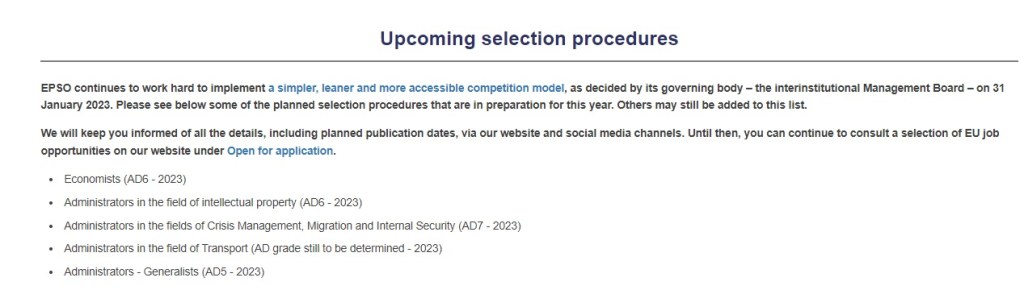
May didn’t started as we expected and the original title of this post (Bad?)EPSO news . after EPSO’s announcement of a new model of competition that should be released on these days, the last set backs such as the cancelation of the AST/154 due to technical failures in the online exam and the European court dismissed appeals have forced EPSO to review its plans in relation with the new competitions. Therefore, the publication of the new competitions such as AD5 Generalist, Economist AD6, Transport Experts or Crisis Management that should begin in May, seems to be delayed at least 1 month or 2 but has been announced for this Summer in the #Openday of the European Institutions in Brussels [check the communication below if you don’t believe us – we stole it from EPSO booth risking our lives…joking they were very kind 🙂 ]

In any case, we will have to wait to see the final outcome of a transformation process inside EPSO to make open competitions faster and simple. This started already in 2020 and particularly after the report from the European Court of Auditors where several conclusion where reached (short summary: selection process proved not to be very efficient for recruiting specialists and it was overall too long).

In the meantime, while we wait to see what is the very final format, let’s share with you the latest news on the publication dates for the next competitions and also what we know or you can also watch the video published by EPSO explaining it (nothing like the original sources)

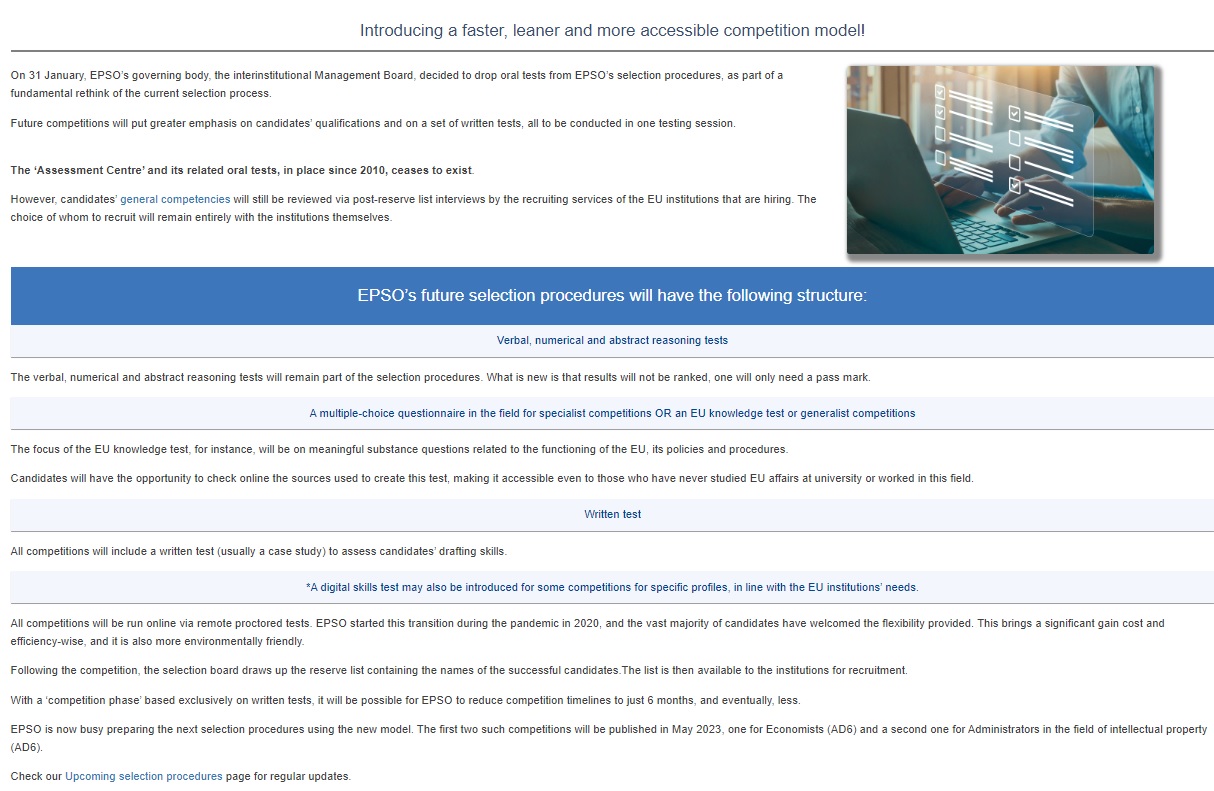
The ‘Assessment Centre’ and its related oral tests, in place since 2010, ceases to exist

EPSO -dixit

So EPSO we know is dead, and the EPSO will live is the making, the EPSOlution (as the new evaluation model has been called by EPSO) is taking is time to come. Wait a second, before you have a stroke, if you are a candidate in an ongoing EPSO competition, forget this post, your competition sticks to the old model (and check what we can do to help you with your Assessment Centre). However, if you will be a candidate soon or you are interested in working in the EU, this post is for you as you still have plenty of questions: What is gone? What stays? When is this really taking place? Let’s see if we can reply to all of them.

Before we continue, if you are interested in our the trainings for the new competitions, you can leave your contact details here, as soon as EPSO consolidates its new model, so we’ll publish the trainings to guarantee you suceed in it.

What is gone?

Talent Screeners are the first victims. Apparently, they will no longer be necessary because the % system that EPSO has been testing over the past months is good enough to evaluate the candidates’ experience in a given field. In some recent competitions, when filling in the section on the job experience in the application, candidates had to indicate which percentage of their working time was dedicated to a specific task. Well, this system will be now the norm as of now to conduct the eligibility checks and to quantify the relevant experience in the field. If you want to know more on this, we explained them in detail in this webinar. Whether EPSO will do the eligibility and relevant experience check both before the exams or split in two actions will be clarified when the new competitions are released.   

Second and more important, the Assessment Centre as we knew it is over. No more interviews with the board of assessors in EPSO premises (previous to COVID-19) or using the platform Cammio. No competence-based interview, oral presentation, situational competency-based interview or any other. If some of these tests re-appear, it will be under the responsibility and supervision of the Institution concerned in the final interviews… What? Keep reading to know more on this.

What stays?

Old rockers never die. The computer based test (CBT) on verbal, numerical and abstract reasoning will stay. Yes, we know it, you don’t like them so much but they can’t get rid of them. The good news is that you will no longer need a high mark in the CBT to make it to the next stage. Now you will only need to get the minimum pass mark. Whatever you get beyond that passing mark, won’t matter. If you are new to this, here in this EPSO examples you can see what kind of tests we are talking about.

What is new?

A multiple-choice questionnaire in the field for specialist competitions or an EU knowledge test or generalist competitions will be the norm now. In both cases nothing to fear, further information regarding what to study will be indicated in the notice of competition and in the invitation letter for the exam (EPSO).

Is that really new? Not exactly, we already had some examples, for instance with Data Protection competition, for which we did a webinar where we explained what to study for this test. In the case of the profiles like AST, most likely, there will be a digital skills test, similar to what we saw in the last Secretaries competition.

In the case of Generalist and the EU knowledge test, don’t panic, it won’t be a trivial for EU freaks. EPSO said: it will be on meaningful substance questions related to the functioning of the EU, its policies and procedures. So it has committed to publish the sources they will use to generate the questions and everybody will have access to them (the resources, not the questions).  

Written tests for all. Yes, that’s right. This is the single competence-based test that remains on this part of the process. If you have done a case study, you know what you are facing. If not, it’s a (usually) 90 min test where they give you some background documents on a topic you don’t know (and is not related to your competition) where you have to answer or fulfil some assignments given about it. Here is an official example provided by EPSO. Remember that this exam aims to assess competences, including drafting skills, but not knowledge on the subject of the competition.  

Another really important question is not what tests will be conducted, but how. All the tests (reasoning tests, multiple-choice tests and written tests will be in one day/session for all in a remote mode. Same system as the remote CBT done in the last competitions, with the difference that it will be longer now. However, important to note that, despite taking all the tests on the same day, your written exam will only be corrected only if you pass the EU knowledge/specialist test and the CBT, making the process much faster.

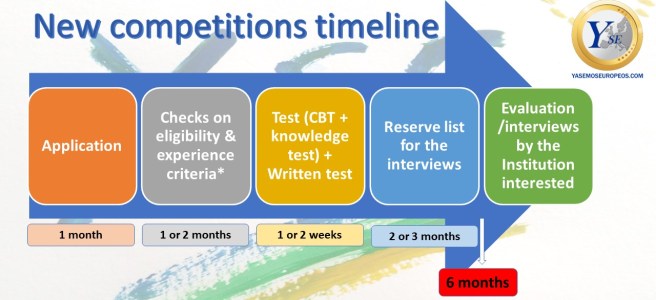
Our humble visualization on how the new competition model-timeline will be

On this point there is also some controversy, as candidates who were used to the old system (and had easy access to the Prometric facilities), as well as those who miss the physical calculator in the numerical reasoning tests, didn’t welcome the change to remote tests. When you had a Prometric centre near home, logistics were much simpler than online, but to be fair, the remote evaluation gave an excellent opportunity for new candidates and particularly those living far from Prometric facilities. Considering this and the fact the new method is cheaper than the old system, we better embrace it and prepare to live with the new monitored-online exams for a long time.  

After passing the tests what?

So if you pass the CBT, the knowledge test and the written test and fulfil all the experience criteria of the competition (that will be stayed in the notice), you will be placed in a reserve list. Only those on the reserve list will have access to the recruitment process organised by each institution. In this process, general competencies will still be reviewed. How? That fall under the criteria of each institution. EPSO will help them only if requested, most likely field-related type interviews will happen, nothing that we can’t not prepare in advance.

When is the change coming?

Who knows now? the new competitions were announced – one for Economists (AD6) and a second one for Administrators in the field of intellectual property (AD6) for May but now all announcements are gone (see below the caption from April, then 3 of May and now, same competitions without dates). Until we get new info, some final changes and adjustments may happen, so with the fresh competition notices in hand, we will update this post with a precise description of the new system and how the competitions will be conducted. In the meantime, we will keep informing you on this and on all the other #eurojobs-related issues, so don’t forget to join our Telegram channel YSE to stay updated.

If you can wait to know how we’ll help with our trainings or you want to be part of the very first study group for the new competitions, register here.

Stay alert! More news coming soon!

Let’s finish with a friky touch in a day like this #Maythe4bewithyou

EPSO ha muerto, larga vida a EPSO

Estimados lectores,

La semana pasada vino con una sorpesa de esas que hacen que te atragantes: el órgano director de EPSO dio a conocer el nuevo sistema de exámenes/oposiciones y el primer anuncio fue llamativo (en la imagen) [English version here]

The ‘Assessment Centre’ and its related oral tests, in place since 2010, ceases to exist…/ El Assessment y sus examenes orales, que funcionaba desde 2010, ha dejado de existir… glups!

EPSO -dixit

Así que EPSO ha muerto, larga vida a «EPSOlution» (como el nuevo modelo de evaluación ha sido llamado por el propio EPSO)… Espera, antes de que te de un infarto, si eres candidato en una oposición EPSO ya en marcha, olvídate de este post, tu oposición se adhiere al modelo antiguo (y recuerda que si estás en el Asssment Centre, podemos ayudarte con esas pruebas). Sin embargo, si vas a ser un candidato o potencial interesado en trabajar en la UE, este post es para ti. Vamos a responder a la avalancha de preguntas que seguramente te estarás haciendo en este momento: ¿Qué pruebas han quitado? ¿Cuáles se quedan? ¿Qué novedades hay? ¿Cuándo llega el nuevo modelo? ¿Por qué todos estos cambios?

¿Qué pruebas han quitado?

Los dichosos Talent Screener son las primeras víctimas. Al parecer, ya no serán necesarios porque el sistema de porcentajes (%) que se probó en paralelo es lo suficientemente bueno para ello. En algunos concursos recientes, al rellenar la sección sobre la experiencia laboral en la solicitud, los candidatos tenían que indicar qué porcentaje de su tiempo de trabajo se dedicaba a una tarea específica. Bueno, este sistema será la norma a partir de ahora para llevar a cabo los controles de elegibilidad y cuantificar la experiencia pertinente en el campo de especialidad requerido. Si quieres saber más sobre esto, te lo explicamos en detalle en este webinar que hicimos. Está por ver si EPSO hará la verificación de elegibilidad y experiencia pertinente antes de los exámenes o se dividirá en dos acciones. Lo sabremos cuando se publiquen las nuevas oposiciones.

Segundo y más importante, el Assessment Centre tal como la conocíamos se acabó. No más entrevistas con los miembros del tribunal de la oposición en las oficinas de EPSO (como se hacía antes de la COVID-19) o utilizando la plataforma Cammio (en la actualidad). No habrá entrevista basada en competencias (CBI para los amigos), presentación oral, entrevista basada en competencias situacionales (SCBI) ni ninguna otra. Si alguna de estas pruebas reaparece, será bajo la responsabilidad y supervisión de la Institución en cuestión en las entrevistas finales… ¿Qué? Sigue leyendo, ahora lo explicamos.

¿Qué se queda?

Igual que los viejos roqueros, la prueba basada en computadora (CBT) de razonamiento verbal, numérico y abstracto permanecerá viva y coleando. Sí, lo sabemos, hubieras preferido cambiarla por otra, pero la realidad es tozuda y EPSO no puede deshacerse de esta prueba. La buena noticia es que en el CBT solo tendrás que aprobar. Es decir, las calificaciones obtenidas más allá del umbral establecido para aprobar no importarán. Si no sabes de qué te hablamos con esto del CBT, te recomendamos estos post donde lo explicamos largo y tendido.

¿Qué novedades hay?

Nos llega que un cuestionario o test de opción múltiple de conocimiento en el campo (para oposiciones especializadas) y una prueba de conocimientos de la UE (para la oposición de generalistas) serán la norma ahora. ¿Es realmente nuevo? No exactamente, ya teníamos algunos ejemplos anteriores, como la oposición de Protección de datos, para la cual hicimos un webinar donde explicamos qué estudiar para el test de conocimientos. En el caso de los perfiles como AST, lo más probable es que haya una prueba de habilidades digitales, similar a lo que vimos en el último concurso de secretarios.

En el caso de los generalistas y la prueba de conocimiento de la UE, que nadie se asuste, no será un trivial para los fanáticos de la UE. EPSO ha indicado: se tratará de cuestiones de fondo significativas relacionadas con el funcionamiento de la UE, sus políticas y procedimientos. Asimismo, se ha comprometido a publicar las fuentes que utilizarán para generar las preguntas y todos tendrán acceso (a los recursos, no a las preguntas ;-)). Esta fórmula tampoco es nueva, ya que los exámenes internos de la Comisión contienen un examen muy similar (si no el mismo).

Prueba escrita para todos (Written test/case study). Sí, así es. Esta es la única prueba para evaluar competencias que permanece en esta parte del proceso. Si ya has hecho un estudio de caso, sabes a lo que te enfrentas. Si no, es una prueba (generalmente) de 90 minutos donde te dan algunos documentos sobre un tema que no conoces (y no está relacionado con tu competencia) donde tienes que responder o cumplir algunas tareas dadas al respecto. Aquí lo contamos con más detalle y aquí tienes un ejemplo proporcionado por la EPSO. Recuerda que este examen tiene como objetivo evaluar las competencias, incluidas las habilidades de redacción, pero no el conocimiento sobre el tema de la oposición. Para eso último está el test.

Probablemente, lo más importante no es el qué sino el cómo. Todas las pruebas (pruebas de razonamiento, test de conocimiento y y prueba escrita) serán en un día/sesión para todos y se realizarán remotamente. Es el mismo sistema que el CBT remoto realizado en las últimas competiciones, con la diferencia de que será más largo ahora al haber varias pruebas. Sin embargo, ten en cuenta que aunque realices todos los tests en un día, tu examen escrito solo se corregirá si has pasasdo la prueba de conocimiento y el CBT, lo que hace que el proceso sea mucho más rápido.

Nuestra humilde propuesta para visualizar el proceso. *- esta por ver si irá todo junto o separado.

En este punto también hay cierta controversia, ya que los candidatos que estaban acostumbrados al sistema antiguo, en las instalaciones de Prométric (el subcontratista oficial de EPSO para ello), no acogieron muy bien el cambio, así como los que echan en falta la calculadora física en la prueba de razonamiento numérico. Para aquellos con un centro Prometric cerca de casa, la logística era mucho más simple que en línea. Pero siendo justos, la evaluación remota ha dado una excelente oportunidad a los nuevos candidatos y particularmente para aquellos que viven lejos de un centro Prometric para participar. Teniendo en cuenta esto y el hecho de que este método es más barato que el antiguo sistema, será mejor que nos hagamos a la idea de vivir con los nuevos exámenes en línea monitoreados durante mucho tiempo. Por el camino, cruzamos los dedos para que todos los problemillas técnicos propios de un nuevo tipo/plataforma de examen se vayan solucionando.

¿Qué pasa después de pasar las pruebas?

Si pasas el dichoso CBT, el test de conocimientos y la prueba escrita y cumples con todos los criterios de experiencia de la oposición (que se indicarán en la convocatoria), te pondrán en una lista de reserva. Solo los que figuren en la lista de reserva tendrán acceso al proceso de contratación organizado por cada institución. En este proceso se seguirán revisando las competencias generales. ¿Cómo? Eso quedará a criterio de la institución organizadora, EPSO solo les ayudará si lo solicitan. Por ahora, lo más probable es que se realicen entrevistas de campo (field-related interview) sobre la especialidad correspondiente, algo que ya conocemos y se puede preparar de antemano.

¿Cuándo pasaremos al nuevo modelo?

En mayo se publicarán las nuevas oposiciónes, una para Economistas (AD6) y otro para Administradores en el campo de la propiedad intelectual (AD6). Hasta entonces, algunos cambios y ajustes finales pueden ocurrir. Por lo tanto, con los nuevos anuncios de oposición en la mano, actualizaremos nuestro análisis de forma precisa, ajustándonos al nuevo sistema (al igual que nuestras formaciones). Mientras tanto, seguimos informándos sobre este y otros asuntos relacionados con los #eurocurros, así que no olvides unirte a nuestro Canal de Telegram YSE  para no perderte nada… pero si quieres saber más sobre lo que haremos, apuntate aquí

Ahora nos queda una última pregunta por responderte…

Aquí lo que se viene por ahora, hay más rumores de otras oposiciones pero nada confirmado aún.

¿Por qué está sucediendo esto?

Estos cambios son el resultado final de un largo proceso de transformación dentro de EPSO para que las oposiciones sean más rápidas y sencillas, queriendo reducirlas de una media de 13 meses a 6 meses de duración. Esto comenzó ya en 2020 y, en particular, después del informe del tribunal de cuentas (Court of Auditors para los amigos), donde se llegó a varias conclusiones y alguna de ellas escoció un poco (resumen breve: el proceso de selección resultaba poco eficiente para la contratación de especialistas y, en general, para todos los perfiles era demasiado largo). Al mismo tiempo que arrancaba la reflexión, llegó la pandemia y fuimos obligados a adoptar el teletrabajo (siempre que fuera posible), de lo cual no se salvó ni el EPSO y cambió a un modo de evaluación online, lo cual también ha influido en el nuevo modelo.

Tampoco olvidemos que durante la pandemia, las oposiciones continuaron, pero a partir de noviembre del año pasado, hubo una pausa de nuevas oposiciones hasta mayo de 2023, igual que generalistas AD5 quedo congelada durante 2021 y 2022. Finalmente, ha llegado el momento de ver los frutos y a principios de 2023, obtuvimos el resultado de esta reflexión, que quedará consolidado cuando tengamos en nuestras manos las nuevas convocatorias.

¡Estad alerta! ¡Más noticias pronto!

EPSO is dead, long live the EPSOlution

Dear all,

Last week brought another surprise to our tables: EPSO’s governing body unveiled the new competition system… and the first announcement was striking (see picture below). [versión en Español]

The ‘Assessment Centre’ and its related oral tests, in place since 2010, ceases to exist

EPSO -dixit

So EPSO is dead, long live the EPSOlution (as the new evaluation model has been called by EPSO). Wait a second, before you have a stroke, if you are a candidate in an ongoing EPSO competition, forget this post, your competition sticks to the old model (and check what we can do to help you with your Assessment Centre). However, if you will be a candidate soon or you are interested in working in the EU, this post is for you as you still have plenty of questions: What is gone? What stays? Why is this happening? When is this really taking place? Let’s see if we can reply to all of them.

What is gone?

Talent Screeners are the first victims. Apparently, they will no longer be necessary because the % system that EPSO has been testing over the past months is good enough to evaluate the candidates’ experience in a given field. In some recent competitions, when filling in the section on the job experience in the application, candidates had to indicate which percentage of their working time was dedicated to a specific task. Well, this system will be now the norm as of now to conduct the eligibility checks and to quantify the relevant experience in the field. If you want to know more on this, we explained them in detail in this webinar. Whether EPSO will do the eligibility and relevant experience check both before the exams or split in two actions will be clarified when the new competitions are released.   

Second and more important, the Assessment Centre as we knew it is over. No more interviews with the board of assessors in EPSO premises (previous to COVID-19) or using the platform Cammio. No competence-based interview, oral presentation, situational competency-based interview or any other. If some of these tests re-appear, it will be under the responsibility and supervision of the Institution concerned in the final interviews… What? Keep reading to know more on this.

What stays?

Old rockers never die. The computer based test (CBT) on verbal, numerical and abstract reasoning will stay. Yes, we know it, you don’t like them so much but they can’t get rid of them. The good news is that you will no longer need a high mark in the CBT to make it to the next stage. Now you will only need to get the minimum pass mark. Whatever you get beyond that passing mark, won’t matter. If you are new to this, here in this EPSO examples you can see what kind of tests we are talking about.

What is new?

A multiple-choice questionnaire in the field for specialist competitions or an EU knowledge test or generalist competitions will be the norm now. Is that really new? Not exactly, we already had some examples, for instance with Data Protection competition, for which we did a webinar where we explained what to study for this test. In the case of the profiles like AST, most likely, there will be a digital skills test, similar to what we saw in the last Secretaries competition.

In the case of Generalist and the EU knowledge test, don’t panic, it won’t be a trivial for EU freaks. EPSO recently said: it will be on meaningful substance questions related to the functioning of the EU, its policies and procedures. So it has committed to publish the sources they will use to generate the questions and everybody will have access to them (the resources, not the questions). This formula is not new either, as the Internal Competition exams in the Commission contains a very similar (if not the same) exam.  

Written tests for all. Yes, that’s right. This is the single competence-based test that remains on this part of the process. If you have done a case study, you know what you are facing. If not, it’s a (usually) 90 min test where they give you some background documents on a topic you don’t know (and is not related to your competition) where you have to answer or fulfil some assignments given about it. Here is an official example provided by EPSO. Remember that this exam aims to assess competences, including drafting skills, but not knowledge on the subject of the competition.  

Another really important question is not what tests will be conducted, but how. All the tests (reasoning tests, multiple-choice tests and written tests will be in one day/session for all in a remote mode. Same system as the remote CBT done in the last competitions, with the difference that it will be longer now. However, important to note that, despite taking all the tests on the same day, your written exam will only be corrected only if you pass the EU knowledge/specialist test and the CBT, making the process much faster.

Our humble visualization on how the new competition model-timeline will be

On this point there is also some controversy, as candidates who were used to the old system (and had easy access to the Prometric facilities), as well as those who miss the physical calculator in the numerical reasoning tests, didn’t welcome the change to remote tests. When you had a Prometric centre near home, logistics were much simpler than online, but to be fair, the remote evaluation gave an excellent opportunity for new candidates and particularly those living far from Prometric facilities. Considering this and the fact the new method is cheaper than the old system, we better embrace it and prepare to live with the new monitored-online exams for a long time.  

After passing the tests what?

So if you pass the CBT, the knowledge test and the written test and fulfil all the experience criteria of the competition (that will be stayed in the notice), you will be placed in a reserve list. Only those on the reserve list will have access to the recruitment process organised by each institution. In this process, general competencies will still be reviewed. How? That fall under the criteria of each institution. EPSO will help them only if requested, most likely field-related type interviews will happen, nothing that we can’t not prepare in advance.

When is the change coming?

In May, the new competitions will be published – one for Economists (AD6) and a second one for Administrators in the field of intellectual property (AD6). Until then, some final changes and adjustments may happen, so with the fresh competition notices in hand, we will update this post with a precise description of the new system and how the competitions will be conducted. In the meantime, we will keep informing you on this and on all the other #eurojobs-related issues, so don’t forget to join our Telegram channel YSE to stay updated.
If you can wait to know how we’ll help with our trainings or you want to be part of the very first study group for the new competitions, register here.

Why is this happening?

These changes are the final outcome of a transformation process inside EPSO to make open competitions faster and simple. This started already in 2020 and particularly after the report from the European Court of Auditors where several conclusion where reached (short summary: selection process proved not to be very efficient for recruiting specialists and it was overall too long). At the same time, due to the pandemic, we were forced to adopt telework whenever possible, which also affected the EPSO competitions.

In the meantime, competitions continued, but since November, new EPSO competitions were frozen until May 2023 and Generalist AD5 has been under re-evaluation during 2021 and 2022. And now, early 2023, we got the result of this reflection.

Stay alert! More news coming soon!