Analysis of Assistants (AST 3) in the fields: 1. Operational security, 2. Technical security and 3. Occupational health and safety, a.k.a EPSO/AST/155/22 competition

Dear all,

Christmas is almost here but before we can enjoy that special time of the year EPSO brings its last competition before the long pause (until May 2023). On the bright side, EPSO has released a new competition offering 101 new positions in 3 different profiles Operational security, Technical security and Occupational health and safety. EPSO aims to close the year with style and offering new opportunities to all of you. Today, we’ll answer the following questions in our analysis of this competition: how many spots are available, languages used in the competition, criteria to be an eligible candidate, the different phases of the competition, as well as our estimated calendar of the competition.

How many spots are available? When does the process begin?

A good number of spots are available, 101 spots in total!!!, distributed in 3 fields. The bad news are that you can only apply to one single field. Be careful! The process began on the 17 November and it will be open for joining until 20 December NOON (let’s say 11.59 AM CET). Until then, you can fill in and validate your application. Approximately, you have been given one month +2 days , that’s more than enough but don’t fall asleep.

if you don’t believe us about the number of spots, just check the notice and do the math

What are the criteria to be a candidate?

The general criteria, as usual: Enjoy full rights as a citizen of a Member State of the EU (of the 27 Member States, sorry, UK is no longer an option), meet any obligations under national laws on military service, and meet the character requirements for the duties concerned.

Specific criteria – languages

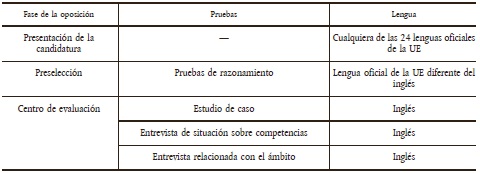
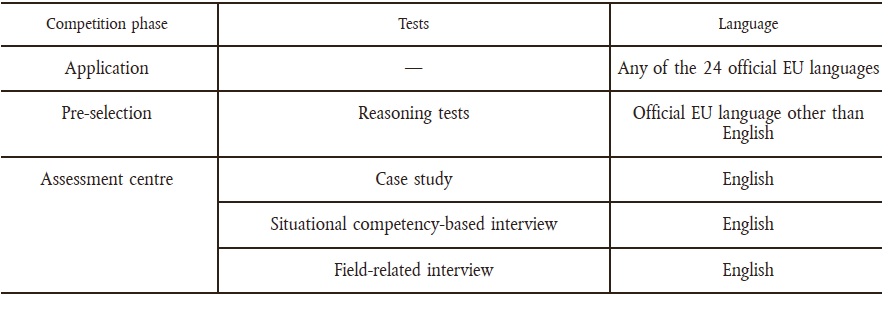
Same thing than in the paragraphs but visible in one look. Also you have a similar table in pag 8 of the notice of competition ;-).

I.-LANGUAGE of the APPLICATION: You can choose among the 24 official languages of the EU and you should have, at least, the ability to write your application in that language. Ok, but the question is, in which language should I draft my application? should I do it English? French? Or my native language if it is none of the previous? You have the right to do it in your EU official (one of the 24) language but nobody guarantees someone from the board will be able to read it and, in such case, they would have to translate it. If so, will all the details of your application be properly captured by the translation? If you are uncertain of the answer, better to use a common use language in the institutions, such as English or French. Besides, the check of the CVs for eligibility criteria will be faster if there is a high number of applications in those languages (English and French). For Spanish and Italian speakers, the chances of having someone who can read them are high so the risk of using them is rather mitigated, for other languages, our answer is that you should verify the chances of having fluent readers of your language in the board of evaluators.

Also on languages, bear in mind that, as a candidate (= after you formally submitted your application) of this competition, EPSO will communicate with you (via the EPSO account or by email) in one of the languages that you have declared to have knowledge of at level B2 or higher in the ‘Ability to read’ section in the application. But if you want to complain about an error in the computer-based multiple-choice questions (MCQs) or do a requests for review you have to submit the requests or complaints in English or French. For other questions is any of the 24 official languages (again, the more spoken the language is, the faster they can deal with your communication)

II.-LANGUAGE of the Reasoning test (CBT) or Language 1: You can choose among 24 official languages of the EU (and different from language 2) and you should have, minimum, a C1 level. For your mother tongue, you should qualify yourself as C2 and be CAREFUL! Do not say you have a level below C1 for any language skill (listening, reading, oral communication, written communication…), otherwise you will be disqualified automatically. The computer-based tests or CBT (verbal, numerical and abstract reasoning) will be taken in that language.

III.-LANGUAGE of the ASSESSMENT CENTRE (or langugage 2) : ENGLISH or FRENCH (sorry, you can’t choose others, duty calls and EPSO explains it long and clear why in the notice). Here we need a B2 level minimum of English/French (no need to have a degree to justify it, the tests in the Assessment Centre will be done in this language and if you can work through them, then you will qualify as having the level required). Remember, when describing your level of English/French in the application, not to put any item (written, oral level, or any other) below B2 level. Of course, this language 2 can’t be the same as language 1.

Specific conditions – Work experience and studies or how to be an elegible candidate?

Let’s proceed profile by profile as each one has its own particularities, but before that…

Be careful! In the part «professional experience in the field or relevant» when describing your professional experience in the application (CV – work experience), you must clearly identify the experiences and activities equal or similar to those you are expected to do in the European Institutions and described in the notice twice (please check our table below): first in point 3.3 Specific conditions (do you need more hints?) and later in Annex I – Typical duties, so take a good look at the columns of our tables, explain your experience and keep calm! If you find this task difficult, perhaps one of our past webinars (click to see the recording) can be key to help you fill in your application.

Field 1 – Operational Security

First thing you need to check is the following table
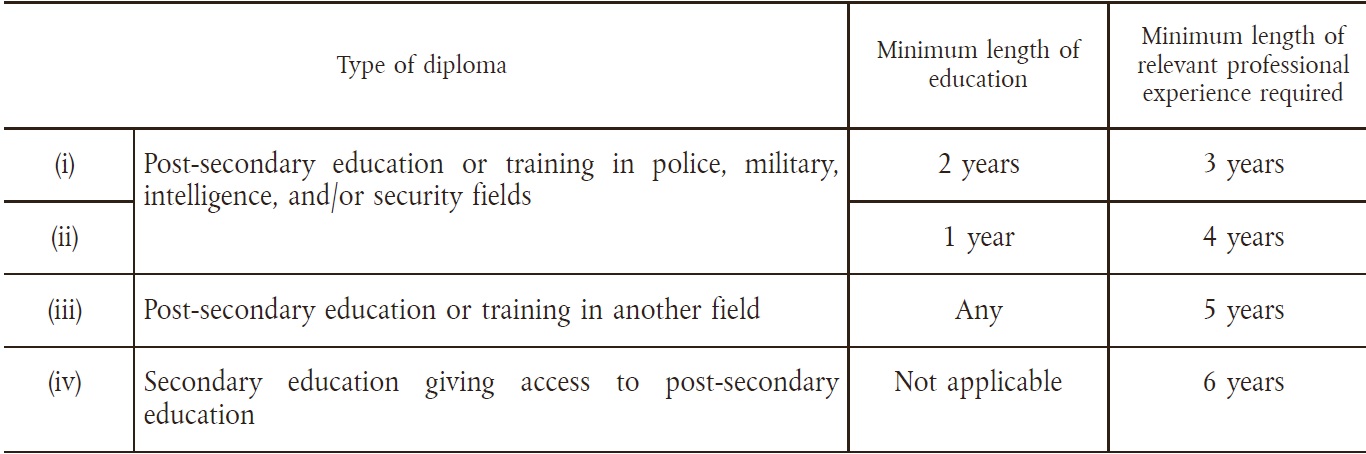
This time, EPSO has prepared a nice table clearly statingthe criteria of what you need to apply

Let’s clarify, ‘a year’ of post-secondary education shall mean a minimum of nine months of effective education or training. Check on page 18 (annex II) onwards to see the corresponding post-secondary degrees by Member State. Also for secondary education you can check the table. Worst case scenario, you don’t have any degree of any type in the areas requested, you will need 6 years of relevant working experience. Knowing this, you can know how many years of working experience (relevant) you need to be eligible.

How to make my experience relevant?

This time it is up to you and to explain it clearly that you have experience in TWO or MORE areas described in the notice (see photo below on the left), by describing your experience on two or more of the areas listed within one of your credited work experience (we insist) and for it, also by using the key words of the task described as a requirement (annex I duties – also copied below on the right). Remember you will have to provide evidence (it must be uploaded before the assessment phase, not now) of all those experiences described (Check annex III point 1 b) to see what it’s accepted to prove it).

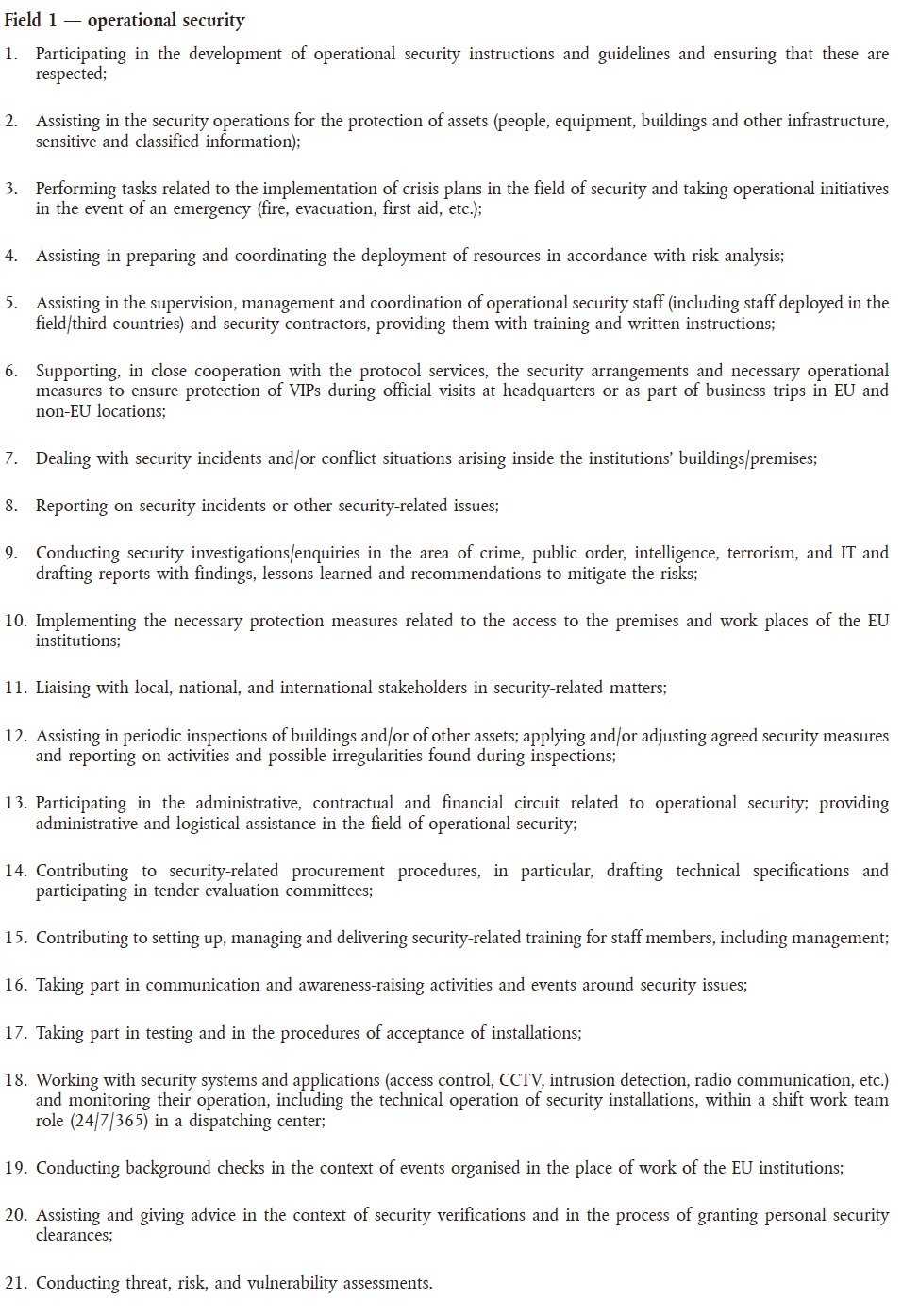
In this way, the responses of all the candidates are structured in the same way, which allows the board to make an evaluation (as objective as such a test allows) of the compared merits of all the candidates and see how many years of relevant experience they got. If you think we can be of help, check one of our past webinar (Also this can help especially with the areas of professional experience to be covered in the CV) where we focused on tips to fill in the CV experience and the Talent Screener for past specialist competitions.

Ahhhh!! Last but not least, for this competition, you need a valid security clearance or you will have to through the process to obtain one. And provide proof of successful fiream training or undergo a test for it. (check the notice for full detail)

Field 2 — Technical Security

You need to satisfy one of the following ((i) to (vi) options
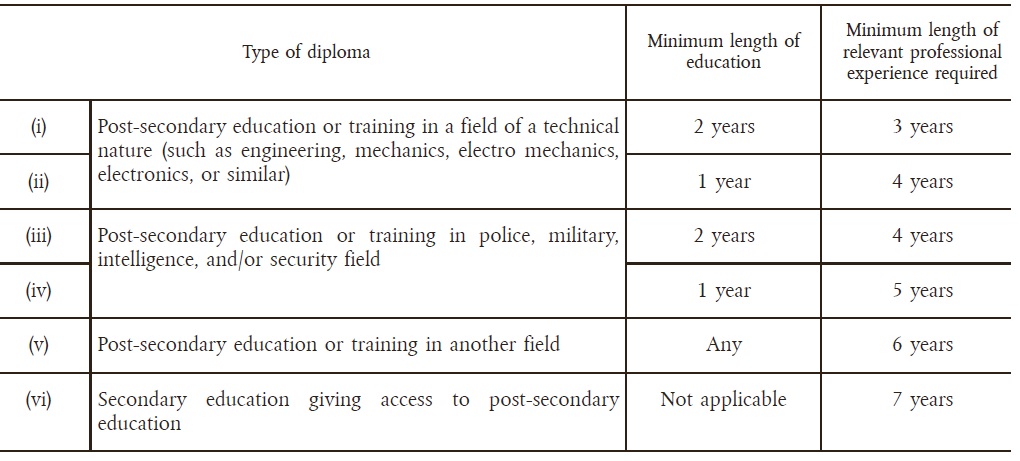
Let’s repeat it, ‘a year’ of post-secondary education shall mean a minimum of nine months of effective education or training. Check on page 18 (annex II) onwards to see the corresponding post-secondary degrees by Member State. The table is contains info for secondary education too. Worst case scenario, you don’t have any degree of any type in the areas requested, you will need 7 years of relevant experience.

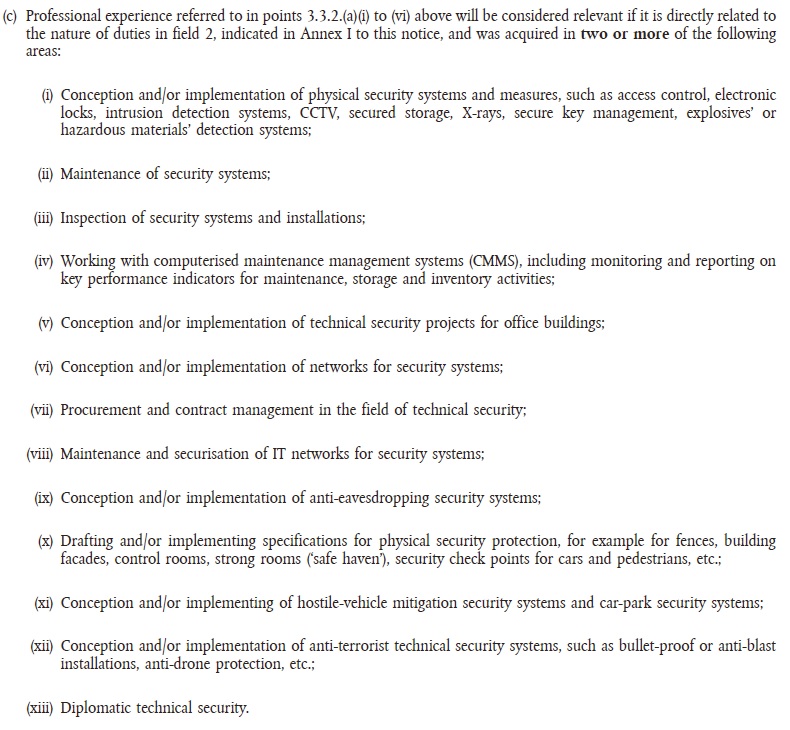
In your professional experience you need to explain clearly that you have experience in TWO or MORE areas described in the notice (see photo below on the left), by describing your experience on two or more of the areas listed (we insist) with the key words or actions covered in the list of duties (annex I duties – also copied below on the right). Remember that you will have to provide evidence (it must be uploaded before the assessment phase, not now) of all those experiences described (Check annex III point 1 b) to see what it’s accepted to prove it). Watch this video where we explain the mechanism of professional experience in a previous competition

Field 3 – Occupational Health and Safety

Same table as in the previous 2 profiles BUT…

They have added one condition – specialist training – How do I get that? Specialist training referred to in point 3.3.3.(a) (image above) will be taken into account if it amounts to at least 136 hours of cumulated training and is directly related to field 3. For example: prevention advisor or designated worker in either safety, ergonomics or psychosocial risks; radiation protection or safety coordinator, etc. For the purpose of this point, one day shall be equivalent to eight hours of training. So if you got a training that indicates it lasted 17 or more days, it means it had 136 hours or more so it will be valid.

Here the academic part becomes more specific, as the notice describes (point 3.3.3(b). picture below) which diplomas are considerer relevant. So if you have a diploma in one of the points (i) to (ix) below, you need max 3 years of experience. If you have a post secondary diploma in any other area different to those points (i) to (ix) below, you will need 5 years. Finally, in case you only completed secondary education, you will need 6 years.

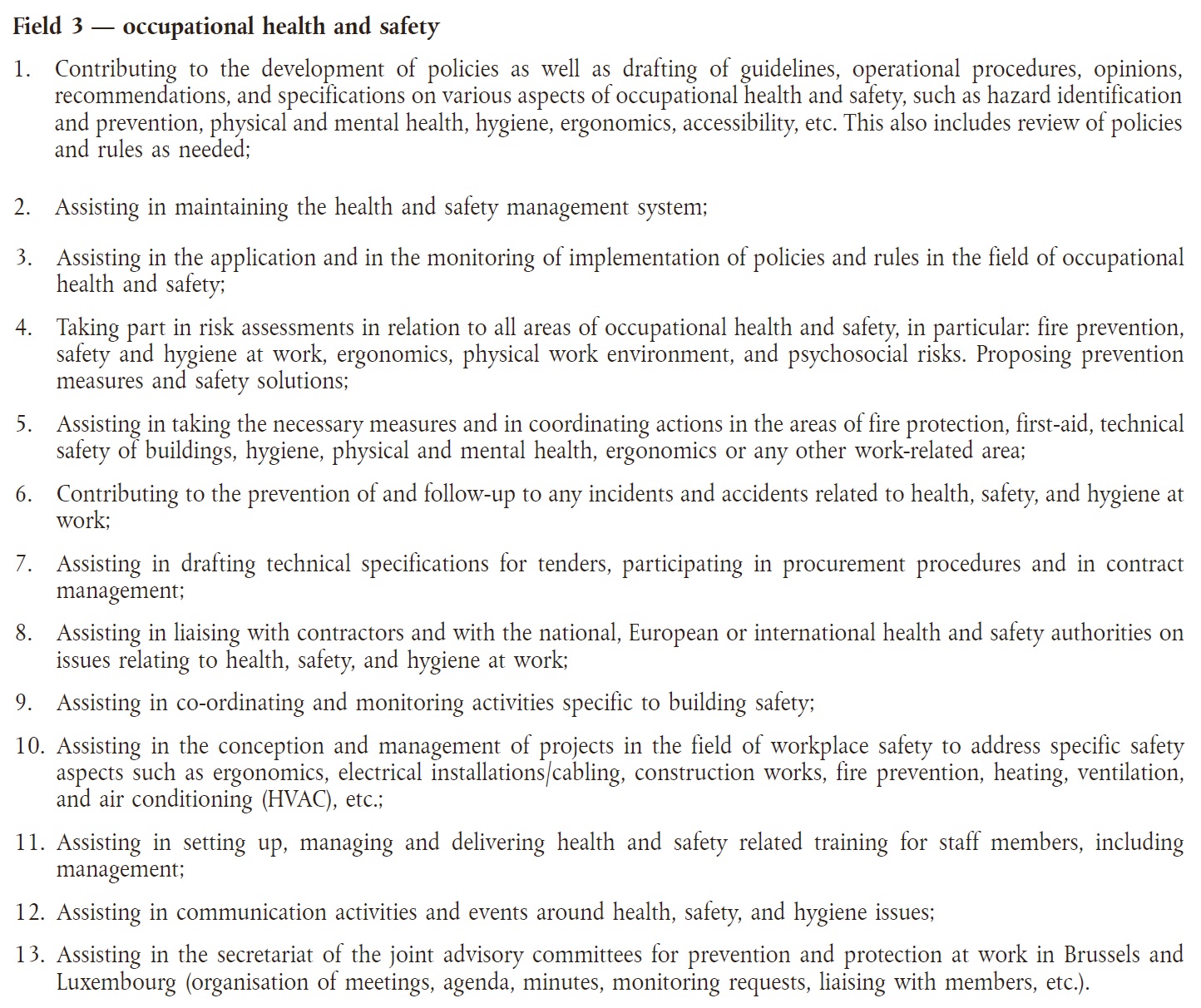
In your professional experience you need to explain clearly that you have experience in TWO or MORE areas described in the notice (see photo below on the left), by describing your experience on two or more of the areas listed (we insist) with the key words or actions covered in the list of duties (annex I duties – also copied below on the right). Remember you will have to provide evidence (it must be uploaded before the assessment phase, not now) of all those experiences described (Check annex III point 1 b) to see what it’s accepted to prove it). Watch this video where we explain the mechanism of professional experience in a previous competition.
What are the tests that I have to pass? And the competition phases?

Based on the notice of competition + our experience, we split the process in 4 phases: 1) fill in the application, 2) CBT 3) elegibility checking 4) the Assessment Centre. The celebration after you have passed the competition is up to you. Before we continue, short advice, join our Telegram channel YSE to be updated in all the steps of this competition, also on EU-vacancies, our trainings and useful infos.

Phase 1 – Fill in the Application

You’ve got until 20 December (noon) to send your application and before that, fill it in with love and care. This is the first step of the process, and the moment to differentiate yourself from the other candidates and all their experience in relation with the six different profiles. So, keep it focused : Work experience + Academic records – these will be used to confirm your eligibility (= whether you have as many years of working experience in the relevant duties as required) so you need to explain your work experience according to the items described in the notice (central and right side column on the tables below).

Phase 2 – CBT – The reasoning test

For this competition, you can expect the reasoning test next year, January 2023- Yes, right after ending the period of application, usually about couple of weeks later, you can expect the time to book your computer-based tests (CBT) test will open but this time overlaps with Christmas, so expect all this to happen after the holidays, most likely the second week of January, then you will take the test either from home (most likely scenario after what has happened in the previous competitions) or from Prometric centers. This time the CBT’s bring an old concept within.

Pay attention, evil…we mean…the trap is in the details

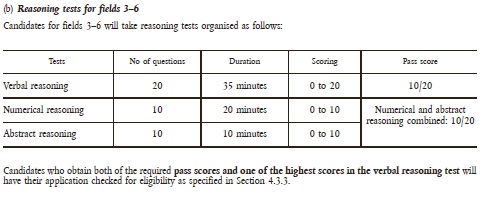
You will have the usual distribution 20 verbal, 10 numerical and 10 abstract reasoning questions. To pass, you don’t need anything great!! right??? BUT, yes now it comes to the big BUT only those candidates who obtain one of the highest scores in the whole test will have their application checked for eligibility until they got positively checked 3 candidates per position and they will be invited to the assessment.

Phase 3 – Eligibility check

Here you can do nothing but wait. It is the task of the board to read first your CV to see if you have all the years of working experience required. It doesn’t matter if you have 20 or 6 years, once you have passed the threshold of having enough experience you go to the assessment. We remind you that the selection based on compliance with the eligibility conditions will be carried out only for those candidates who pass the CBT and by decreasing order in their overall result. You should therefore include all the relevant information in your application form. The best of all this is, after the evaluations, the number of candidates who will go to the Assessment Centre will be only up to 3 times the amount of openings. We are talking approximately 300 candidates in total and you are one of them because you have written a great application  🏆.

Phase 4 – Assessment Centre

Congrats! You are one of the candidates with the highest marks in the CBT, you have the required experience and you have been invited to the Assessment Centre. We have reached the final round, in which we will also have to present all our documents related to education and professional experience in digital format (they need to be uploaded into a platform before doing the Assessment Centre tests), so prepare them in advance to avoid a last minute rush with the bureaucracy.

Now talking about the other tests, the competition turns into a classic. You will have to face the following tests: Case Study and Situational Competency-Based Interview. Here you have 7 competences to be assessed (in AD competitions there are eight). Between the two tests you can gather a total of 70 points, with the particularity that you need an overall 35/70 to pass, but no minimum marks per competence. Don’t get over confident, do fine on these two and you will be fine for this part although the more points we get the better (we can help with that).

Some practice, some effort and a some guidance and it will be done 😉
When you see your name on the reserve list

Anyway, the key part is the field-related test where you will have to show your knowledge on the field, explaining, in detail, your relevant experience for this position. The Interview in the Field is also somehow structured but as it has a clear focus on your work experience, is much more interesting and rewarding, you can get up to 100 points in that test (we can help on that too), approx. 60% of all the available points.

Final Step – After a long process and passing the Assessment Centre, EPSO will check the validity of all your records and professional experiences (comparing them to the input of your application). For these, they will use the documents uploaded at the beginning of phase 4 – right before your first test of the Assessment Centre. So, keep your documents ready for upload once you have passed the eligibility check!!! Once you get the final OK for this part, you will see your name on the reserve list and ready to find a job as officer of the European institutions.

What is the timing of the competition? When will EPSO contact me?
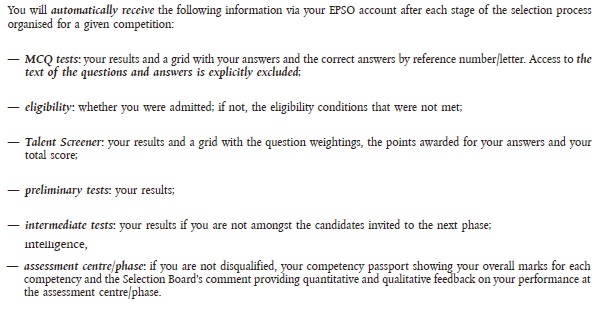
All the situations under which EPSO will write you in your profile, not by email, although sometimes we may get a warning message.

The expected calendar for this competition is the following: after the closure date for the submission of the applications, end-december, you will have the opportunity to book your CBT slot, most likely mid-november, then taking the CBT end January or begining of February. After that, they will run the eligibility checks in Winter/early Spring, and then the Assessment will come end-Spring onwards. So get ready to confront the CBT very soon and the Assessment Centre in Spring 2023!!

Many of you ask about when EPSO will tell you that you have passed to the next phase, or have been invited to the Assessment Centre, or…. you read/heard rumors about the development of the competitions somewhere. Better to isolate yourself from that noise and focus on the real messages. EPSO commits itself (it’s in Annex III of the notice of competition) to communicate with you after the applications have been evaluated to inform you on the results and to invite you to the Assessment Centre. In the meantime, it can take weeks or months to receive any information or being notified that we have passed to the next phase of the competition, so keep calm. If you are feeling desperate for the lack of news, you can always contact EPSO too, as candidates you are entitled to do so but be careful, replies can be a bit cryptic or copy/paste from the notice.

How much will my salary be?

Table of the amounts of basic monthly salaries for each grade and step in function groups AD and AST referred to in Article 66 of the Staff Regulations, applicable from 1 July 2021

One of the most typical questions of the candidates is the salary that you will get. An AST3 (step 2) will join the institutions with a salary starting at 4.500 € and this can be higher depending if you have dependent family members and other conditions. To that amount, you will have to add 16% extra of expatriation allowance and subtract the cost of the taxes (you pay taxes to the European Commission), health insurance and pension, all them proportional to your salary, so expect around the same amount, 4.000 € in net salary. By the way, we refer to step 2 as any first entrant in the institutions can’t join above that step, it means you have at least 3 years of professional experience, what in this competition, is obvious. And if you are worried about life in expensive countries the basic remuneration is supplemented by an allowance linked to the living conditions prevailing at the place of employment, so don’t worry too much.

Can you help me?

Let share some useful links for this competition and any other.

List of useful resources

  1. El CBT o los test psicotécnicos (ES)
  2. The Assesment centre (EN)
  3. 10 free resources (EN/ES).
  4. YSE trainings (English and Spanish) :
    1. CBT (in Spanish)
    2. Assessment sessions – for all the Assessment test (Theory in English or Spanish. Practice can be done in EN,FR,ES)
    3. Application review (EN/ES/FR/IT/DE)
    4. CAST Sessions -have you been invited to a job interview? Do you want to improve your chances of being selected in a CAST process?

Análisis de la oposición de Assistentes (AST 3) en 6 ámbitos: 1. Gestión financiera; 2. Contabilidad y tesorería; 3. Contratación pública; 4. Diseño gráfico; 5. Redes sociales; 6. Webmaster y todo dicho en corto oposición EPSO/AST/154/22 .

Queridos todos,

El otoño está aquí y las hojas de los árboles van cayendo e igualmente lo hacen las vacantes y las oportunidades para trabajar en la institución europea. EPSO ha publicado una nueva oposición que nos ofrece 492 nuevos puestos (casi 500 si eres de los que prefiere números redondos) para una amplia gama de perfiles, desde expertos en gestión financiera y contabilidad hasta expertos en medios de comunicación ( redes sociales, webmaster, diseño gráfico) terminado por expertos en contratación pública y licitaciones. Las instituciones europeas necesitan cada vez más perfiles técnicos altamente especializados, el mundo está cambiando y tú puedes formar parte de ese cambio. Si buscas la versión en inglés de este artículo, pincha aquí

¿Cuántas plazas hay? ¿Hasta cuando puedo presentar la candidatura?

Tenemos un buen número de plazas disponibles ¡¡¡492 plazas en total!!!, distribuidas en 6 ámbitos. Las malas noticias son que sólo puedes presentarte a un ámbito de los seis, así que eligelo con tiento y criterio. El proceso arrancó el 22 de septiembre y cerrará el día 25 de octubre (AL MEDIODIA) Hasta entonces , puedes completar y validar tu candidatura. En total nos han dado un mes y un par de días, asi que nada de dormirse en los laureles.

Si no te crees el númer ode plazas, tan sólo verificalo en la convocatoria de la oposición y haz la suma.

¿Cuáles son los criterios para ser candidato?

Los criterios generales, como de costumbre: Gozar de plenos derechos como ciudadano de uno de los veintisiete Estados miembros de la UE (el Reino Unido ya no es una opción), cumplir las obligaciones derivadas de la legislación nacional en materia de servicio militar y cumplir los requisitos de carácter para las funciones de que se trate.

Criterios específicos – Los idiomas

I.-IDIOMA de la SOLICITUD: Puedes elegir entre las 24 lenguas oficiales de la UE y, como mínimo, deberías tener la capacidad para redactar la candidatura en esa lengua. OK, jajaja muy divertido, pero la pregunta es ¿En qué lengua debo redactar mi solicitud? ¿Debería hacerlo el inglés? ¿francés o en mi lengua materna? Tienes derecho a hacerlo en tu lengua oficial, pero nadie garantiza que alguien del tribunal de la oposición pueda leerlo y, en tal caso, tengan que traducirlo. En ese caso, la siguiente pregunta es ¿sobrevivirán todos los detalles de mi solicitud a la traducción? Si no lo tienes por seguro, plantéate lo siguiente ¿no será mejor utilizar una lengua de uso común en las instituciones, así controlo lo que pongo? Y es ahí entrarán el inglés y el francés. Además, la verificación de los criterios de admisibilidad de los CV será proporcionalmente más rápida al número de solicitudes en esas lenguas (inglés y francés). En el caso de los hablantes españoles e italianos, las posibilidades de que alguien pueda leerlos (aún sin ser nativos) son elevadas, por lo que el riesgo de utilizarlos está bastante mitigado; para otras lenguas, nuestra respuesta es que pienses antes cuales son las posibilidades de tener lectores fluidos de tu lengua en el tribunal de la oposición.

Lo mismo que hemos dicho antes pero ordenado por EPSO. Puedes verlo en la página 8 de la convocatoria 😉

Siguiendo con el tema de los idiomas , ten en cuenta que, como candidato oficial (= después de haber presentado oficialmente su candidatura) de esta oposición, la EPSO se comunicará (a través de la cuenta EPSO o por correo electrónico) contigo en una de las lenguas que hayas declarado tener conocimientos de nivel B2 o superior en la sección «Capacidad de lectura» del formulario de candidatura. Sin embargo, si lo que quieres es denunciar un error en las preguntas de opciones múltiples por ordenador (el CBT) o solicitar una revisión de alguna de los resultados, tienes que presentar las solicitudes o reclamaciones en inglés o francés. Para otras preguntas, cualquiera de las 24 lenguas oficiales (de nuevo, cuanto más hablada sea la lengua, más rápido podrán tratar su comunicación)

II.-IDIOMA de los test psicotécnicos (CBT): Para los clásicos test de razonamiento verbal, razonamiento numérico y razonamiento abstracto, puede elegir entre 24 23 lenguas oficiales de la UE, todas excepto INGLÉS, y debe tener, como mínimo, un nivel C1. Si es tu lengua materna, deberías calificarte como C2 y tener mucho cuidado. No digas que tienes un nivel inferior a C1 para ninguna competencia lingüística (escucha, lectura, comunicación oral, comunicación escrita, etc.), so pena de ser descalificado automáticamente. Las pruebas por ordenador o CBT (razonamiento verbal, numérico y abstracto) se realizarán en esa lengua declarada como lengua 1 (insistimos por si no quedó claro). Y si necesitas apoyo con estos test, puedes unirte a uno de nuestros cursos de CBT (pronto empieza el siguiente) .

III.-IDIOMA del Assessment: INGLÉS o INGLÉS (lo sentimos, estos son lentejas y no puedes elegir, el deber obliga y la EPSO explica las razones de esta elección claramente en la convocatoria). Aquí necesitaremos un nivel B2 mínimo de inglés (no es necesario tener un diploma o título para justificarlo, las pruebas en el Centro de Evaluación se realizarán en esta lengua y si puede trabajar/examinarte con ella, se considerará que tiene el nivel requerido). Recuerda que, al describir su nivel de inglés en la solicitud, no coloques ningún elemento (tú nivel de escrito, oral o lectura) por debajo del nivel B2.

Condiciones específicas – Experiencia profesional y estudios

Vamos poco a poco, agrupando el perfil 1 y 2 y luego hablaremos de los perfiles del 3 al 6, así los criterios de lo que nos piden, serán más visibles para todos.

¡Cuidadín! Para explicar la parte «experiencia profesional en el ámbito», como en este caso, significa que, al describir su experiencia profesional en la solicitud (CV — experiencia laboral), los candidatos deben identificar claramente las experiencias y actividades iguales o similares a las que se espera que realicen en las instituciones europeas y descritas en el anuncio dos veces (consulte nuestro cuadro): en primer lugar, en el punto 3.3 Condiciones específicas (¿necesita más explicaciones?) y más tarde en el anexo I — Funciones atípicas, por lo que mira bien las columnas de nuestros cuadros, explique su experiencia y no desespere. Si considera que esta tarea es difícil, quizás nuestro próximo seminario web (martes 11 octubre 19 h CET) webinar( click para ver el video) sobre esta oposición pueda ser clave para darte ideas de cómo afrontar la oposición.

Las pruebas a superar y las distintas fases de la oposición

Tomando como referencia la convocatoria de oposición + nuestra experiencia, el proceso lo hemos dividido en 4 fases: 1) rellenar la solicitud, 2) CBT 3) verificación de la admisibilidad 4) el Centro de Evaluación. Por último, el fiestorro una vez superada la oposición queda a tu discreción. Antes de arrancar, si quieres que vayamos informando de avances en esta oposición, vacantes y cosillas de utilidad, unete a nuestro canal de Telegram YSE

Fase 1 – Rellenar la candidatura

Tenemos hasta el 25 de octubre (mediodía) para enviar la solicitud y, antes, toca rellenarla con amor y cuidado. Este es el primer paso del proceso y el momento de diferenciarse de los demás candidatos y de toda su experiencia en relación con los seis perfiles diferentes. Así pues, mantente centrado en explicar bien tu Experiencia laboral + cualificaciones pues estos se utilizarán para confirmar tu admisibilidad (= tienes tantos años de experiencia laboral en las funciones pertinentes como sea necesario). Esto significa que debemos explicar nuestra experiencia laboral con arreglo a los puntos descritos en la convocatoria (columnas central y derecha del cuadro que viene a continuación – están inglés porque asumimos que la mayoría de los candidatos usaréis esa lengua para la candidatura, sino aquí está la convocatoria en español).

Ámbito 1 -Gestión Financiera & Ámbito 2 – Contabilidad y tesorería

Ámbito 3 – Contratación Pública & Ámbito 4 Diseño Gráfico y producción de contenidos visuales & 5 Medios digitales y redes sociales & 6.- webmaster (administradores de sitios web) (haz click en las flechas laterales para ir cambiando de tabla)

… (¡para el carro! Estamos todavía en la fase 1) ¿Cómo puedo demostrar que mi experiencia es pertinente? Esta vez te toca explicarlo claramente utilizando las palabras clave de las tareas descrita como requisito (insistimos). Recuerda que tendrás que aportar evidencias (papeles que la prueben) de todas las experiencias descritas en tu candidatura (consulta el anexo III, punto 1, letra b para ver que papeles se aceptan para justificarlas).

De este modo, las respuestas de todos los candidatos estarán estructuradas de la misma manera, lo que permite al tribunal de la oposición realizar una evaluación (tan objetiva como lo permite el proceso) de los méritos de todos los candidatos. Si crees que podemos ayudarte, echa un vistazo a nuestro anterior webinar, en el que nos centramos en los consejos para rellenar la candidatura y el Talent Screener de oposiciones especializadas. PERO, si está buscando una visión totalmente aplicada a esta oposición, vente a nuestro próximo seminario web (martes 11 octubre 19 h CET) a ver el webinar que hicimos( click para ver el video).

Fase 2- CBT — La prueba de razonamiento

Justo después de finalizar el período de inscripción, unas dos semanas más tarde, podemos esperar esperar que se abra el tiempo para reservar la prueba por ordenador (CBT) y que se realicen la prueba desde casa o desde los centros Prometric durante la segunda quincena de noviembre y principios de diciembre. Y aquí llega la sorpresa, esta vez los CBT aportan una sorpresa oculta.

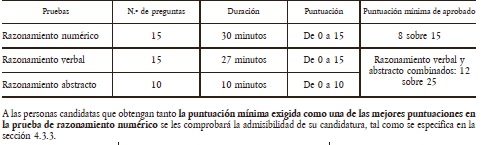
Para el ámbito 1 — Gestión financiera & ámbito 2 — Contabilidad y tesorería, tendrás 15 preguntas en el razonamiento numérico (5 más de lo habitual), mientras que en el razonamiento verbal sólo 15 (5 menos de lo habitual). Para superarlo necesitarás 8 de cada 15 puntos en el numérico y 12 de 25 de la puntuación combinada de BUT verbal y abstracta, pero ahora viene gran PERO, sólo los candidatos que obtengan una de las puntuaciones más altas en la prueba de razonamiento numérico serán sometidos a una comprobación de su admisibilidad, ya que esta verificación se hará por orden de nota hasta completar 3 veces el número de vacantes disponibles (y siempre que también tengamos el mínimo de 12 sobre 25 para verbal + abstracto). Recuerda que si necesitas apoyo con estos test, puedes unirte a uno de nuestros cursos de CBT (pronto empieza el siguiente)

Presta atención, el diablo se esconde en los detalles

Y si vamos al ámbito 3 — Contratación pública — ámbito 4 — Diseño gráfico y producción de contenidos visuales- ámbito 5 — Medios sociales y digitales, ámbito 6 — Webmaster, la imagen cambiará un poco. Volvemos a la distribución clásica de 20 preguntas verbales, 10 numéricas y 10 abstractas. Para superarlo, necesitarás 10 de 20 verbales y 10 de 20 de la puntuación combinada de numérico y abstracto, sí ahora el gran PERO. También en estos ámbitos o perfiles, las verificaciones de cumplir con los criterios de admisibilidad se harán por orden decreciente de puntuación en el razonamiento verbal (y siempre que tengamos el mínimo de 10 sobre 20 para numérico + abstracto) hasta completar el cupo de 3 candidatos por plaza ofertada ( Permítenos que insistamos, que luego sólo os acordáis de la croqUEta de YSE cuando quedan 2 días para el examen , aquí el enlace para informarte y/o unirte a nuestro próximo curso de CBT )

La distribucion de preguntas y puntos de siempre con la salvedad que tenemos que sacar un buen resultado en verbal.

Fase 3 — Verificación de la admisibilidad

Aquí no puede hacer nada más que esperar. Corresponde al Tribunal de la oposición leer tu candidatura para ver si tiene todos los años de experiencia laboral requeridos(y los estudios correspondientes). No importa si tiene 20 o 6 años, una vez que haya superado el umbral de experiencia suficiente para pasar a la evaluación. Te recordamos que la selección basada en el cumplimiento de las condiciones de admisión solo se llevará a cabo para los candidatos que superen el CBT y por orden decreciente en su resultado numérico (perfil 1 y 2) o verbal (perfiles 3-4-5-6) (por si no quisiste leer la fase 2). Por lo tanto, debe incluir toda la información pertinente en tu formulario de candidatura. Lo mejor es, tras las evaluaciones, solo 3 veces las aperturas se dirigirán al Centro de Evaluación. Hablamos de un total aproximado de 1500 candidatos y estamos seguro que tú serás uno de ellos porque habrás escrito una gran candidatura 🏆 después de asistir a nuestro webinar.

Fase 4 — Centro de evaluación.

¡Enhorabuena! Eres uno de los candidatos que has obtenido las mejores puntuaciones en el CBT, cuentas con la experiencia requerida y por tanto has sido invitado al Centro de Evaluación. Hemos llegado a la ronda final, en la que también tendremos que presentar todos nuestros documentos relacionados con la educación y la experiencia profesional en formato digital (deberán cargarse en una plataforma antes de realizar las pruebas del Centro de Evaluación), por lo que los prepararemos con antelación para evitar una carreras de última hora con la burocracia.

Hablando de las pruebas a las que nos vamos a enfrentar, la oposición pasa a ser clásica. Los candidatos deberán someterse a lo siguiente: Estudio de casos y entrevista basada en competencias situacionales: aquí tienen 7 competencias que deben evaluarse (en las oposiciones AD hay ocho). Entre las dos pruebas, puede reunir un total de 70 puntos, con la particularidad que necesita y, en total, 35/70 para aprobar, pero no las puntuaciones mínimas por competencia, no confían en estas dos pruebas, pero sí lo harás por esta parte, aunque cuantos más puntos obtengamos mejor (con estas pruebas, llegado el momento, también podemos ayudar).

Algo de práctica , un poco de esfuerzo y algo de guía y tenemos la receta perfecta para aprobar.
When you see your name on the reserve list

En cualquier caso, la parte clave es la prueba relacionada con el campo (field related interview), en la que tendrá que demostrar sus conocimientos técnicos sobre el terreno, explicando detalladamente su experiencia pertinente para este puesto. La entrevista en el campo también está de alguna manera estructurada, pero, puesto que se centra claramente en su experiencia laboral, es mucho más interesante y gratificante, puede obtener hasta 100 puntos en esa prueba (también podemos ayudar con esta), aproximadamente el 60 % de todos los puntos disponibles.

Paso final: tras un largo proceso y tras superar el Centro de Evaluación, la EPSO comprobará la validez de todos sus expedientes y experiencias profesionales (comparándolos con las aportaciones de su candidatura). Para ello, utilizarán los documentos cargados al comienzo de la fase 4, justo antes de la primera prueba del Centro de Evaluación. Así pues, mantente listo para cargar los documentos una vez que hayas superado el control de admisibilidad. Una vez que obtenga el OK final para esta parte y tras una espera (larga o corta dependerá de tu paciencia), verás tu nombre en la lista de reserva y estarás listo para encontrar un puesto de funcionario de las instituciones europeas.

¿Cuál es el calendario de la convocatoria? ¿Cúando me va a contactar EPSO?

All the situations under which EPSO will write you in your profile, not by email, although sometimes we may get a warning message.

El calendario previsto para esta competición es el siguiente: después de la fecha de cierre para la presentación de las solicitudes y realizar el test psicotécnicio ( CBT), se llevarán a cabo los controles de elegibilidad en otoño y luego el Talent Screener durante el invierno. ¡Así que prepárate para enfrentarte al CBT este otoño y al Centro de Evaluación en la primavera de 2023!

¿Cuándo se pondrá en contacto conmigo la EPSO? Muchos nos preguntain cuándo os dirá EPSO que habeis pasado a la siguiente fase, o si habéis sido invitados al assessment tras pasar la evaluación de los años de experiencia, o… habeis leído o escuchado rumores sobre el desarrollo de los concursos (el primo de la prima del primo de la…. ha dicho que…). Es mejor aislarse de ese ruido y centrarse en los mensajes reales, EPSO se compromete (en el anexo II del anuncio) a comunicarse con todos los candidatos después de que hayan pasado la fase de elegiblidad e igualmente después del Talent Screener para informar de los resultados e invitarte al Assessment. Mientras tanto, puede llevar semanas o meses recibir cualquier información, así que mantén la calma. En caso de duda, puedes ponerte en contacto con EPSO también, ya que los candidatos teneis derecho a hacerlo, pero ten cuidado, las respuestas pueden ser un poco crípticas o un simple copiar/pegar de la notificación, no esperes grandes aclaraciones.

¿Cuánto voy a ganar?

Table of the amounts of basic monthly salaries for each grade and step in function groups AD and AST referred to in Article 66 of the Staff Regulations, applicable from 1 July 2021

Una de las preguntas más típicas de los candidatos. Un AST3 (paso 2) se incorporará a las instituciones con un salario de salida superior a 4,000 EUR y esto puede ser mayor dependiendo de si tienes familia dependiente de ti y otras condiciones. A eso tendrás que sumar un 16 % extra de tasa de expatriación y restar el coste de los impuestos (pagas impuestos a la Comisión Europea), seguro de salud y pensión, todos ellos proporcionales a tu salario, así entre lo que entra y sale, espera alrededor de la misma cantidad, 4,000 EUR, en salario neto. Por cierto, nos referimos al step 2 ya que cualquiera que entra nuevo en las instituciones no puede entrar por encima de ese «step», ese nivel se adquiere si demuestras que tienes al menos 3 años de experiencia profesional, lo que en esta oposición, es obvio. Y si te preocupa la vida en países caros, la remuneración básica se complementa con una asignación vinculada a las condiciones de vida que prevalecen en el lugar de trabajo, así que no es para tanto 

¿Podéis ayudarme?

Van unos enlaces de interés

List of useful resources

  1. El CBT o los test psicotécnicos (ES)
  2. The Assesment centre (EN)
  3. 10 free resources (EN/ES).
  4. YSE trainings (English and Spanish) :
    1. CBT (in Spanish)
    2. Assessment sessions – for all the Assessment test (Theory in English or Spanish. Practice can be done in EN,FR,ES)
    3. Application review (EN/ES/FR/IT/DE)
    4. CAST Sessions -have you been invited to a job interview? Do you want to improve your chances of being selected in a CAST process?

Analysis of Assistants (AST 3) in 6 the fields: 1. Financial management; 2. Accounting; 3. Public procurement; 4. Graphic design; 5. Social media; 6. Webmaster, a.k.a EPSO/AST/154/22 competition

Dear all,

We are now at that time of the year when tree leaves are falling… and so are the vacancies and opportunities to work in the European Institutions! EPSO has released a new competition offering 492 new positions (almost 500 if you prefer round numbers) to a wide range of profiles from experts in financial management, accounting and public procurement to media experts (social, web, graphic design). The European Institutions need more and more highly specialized technical profiles, the world is changing and you can be a part of that change. Spanish version of this post available here.

How many spots are available? When does the process begin?

A good number of spots are available, 492 spots in total!!!, distributed in 6 fields. The bad news are that you can only apply to one single field. Be careful! The process began on the 22 September and it will be open for joining until 25 October NOON (let’s say 11.59 AM CET). Until then, you can fill in and validate your application. Approximately, you have been given one month +2 days , that’s more than enough but don’t fall asleep.

if you don’t believe us about the number of spots, just check the notice and do the math

What are the criteria to be a candidate?

The general criteria, as usual: Enjoy full rights as a citizen of a Member State of the EU (of the 27 Member States, sorry, UK is no longer an option), meet any obligations under national laws on military service, and meet the character requirements for the duties concerned.

Specific criteria – languages

Same thing than in the paragraphs but visible in one look. Also you have a similar table in pag 8 of the notice of competition ;-).

I.-LANGUAGE of the APPLICATION: You can choose among the 24 official languages of the EU and you should have, at least, the ability to write your application in that language. Ok, but the question is, in which language should I draft my application? should I do it English? French? Or my native language if it is none of the previous? You have the right to do it in your EU official (one of the 24) language but nobody guarantees someone from the board will be able to read it and, in such case, they would have to translate it. If so, will all the details of your application be properly captured by the translation? If you are uncertain of the answer, better to use a common use language in the institutions, such as English or French. Besides, the check of the CVs for eligibility criteria will be faster if there is a high number of applications in those languages (English and French). For Spanish and Italian speakers, the chances of having someone who can read them are high so the risk of using them is rather mitigated, for other languages, our answer is that you should verify the chances of having fluent readers of your language in the board of evaluators.

Also on languages, bear in mind that, as a candidate (= after you formally submitted your application) of this competition, EPSO will communicate with you (via the EPSO account or by email) in one of the languages that you have declared to have knowledge of at level B2 or higher in the ‘Ability to read’ section in the application. But if you want to complain about an error in the computer-based multiple-choice questions (MCQs) or do a requests for review you have to submit the requests or complaints in English or French. For other questions is any of the 24 official languages (again, the more spoken the language is, the faster they can deal with your communication)

II.-LANGUAGE of the Reasoning test (CBT): You can choose among 24 23 official languages of the EU, all except ENGLISH and you should have, minimum, a C1 level. For your mother tongue, you should qualify yourself as C2 and be CAREFUL! Do not say you have a level below C1 for any language skill (listening, reading, oral communication, written communication…), otherwise you will be disqualified automatically. The computer-based tests or CBT (verbal, numerical and abstract reasoning) will be taken in that language.

III.-LANGUAGE of the ASSESSMENT CENTRE: ENGLISH or ENGLISH (sorry, you can’t choose, duty calls and EPSO explains it long and clear why in the notice). Here we need a B2 level minimum of English (no need to have a degree to justify it, the tests in the Assessment Centre will be done in this language and if you can work through them, then you will qualify as having the level required). Remember, when describing your level of English in the application, not to put any item (written, oral level, or any other) below B2 level.

Specific conditions – Work experience and studies

Let’s proceed by grouping fields, we will first deal with field 1 and 2 and then with profiles from 3 to 6. in an orderly manner so the criteria are more visible to all you.

Be aware! In the part «professional experience in the field or relevant» when describing your professional experience in the application (CV – work experience), you must clearly identify the experiences and activities equal or similar to those you are expected to do in the European Institutions and described in the notice twice (please check our table below): first in point 3.3 Specific conditions (do you need more hints?) and later in Annex I – Typical duties, so take a good look at the columns of our tables, explain your experience and keep calm! If you find this task difficult, perhaps our next webinar on this competition that will take place on 11 October webinar( click to see the recording) can be key to help you fill in your application.

What are the tests that I have to pass? And the competition phases?

Based on the notice of competition + our experience, we split the process in 4 phases: 1) fill in the application, 2) CBT 3) elegibility checking 4) the Assessment Centre. The celebration after you have passed the competition is up to you. Before we continue, remember you can join our Telegram channel YSE to be updated in all the steps of this competition, vacancies, our trainings and useful infos.

Phase 1 – Fill in the Application

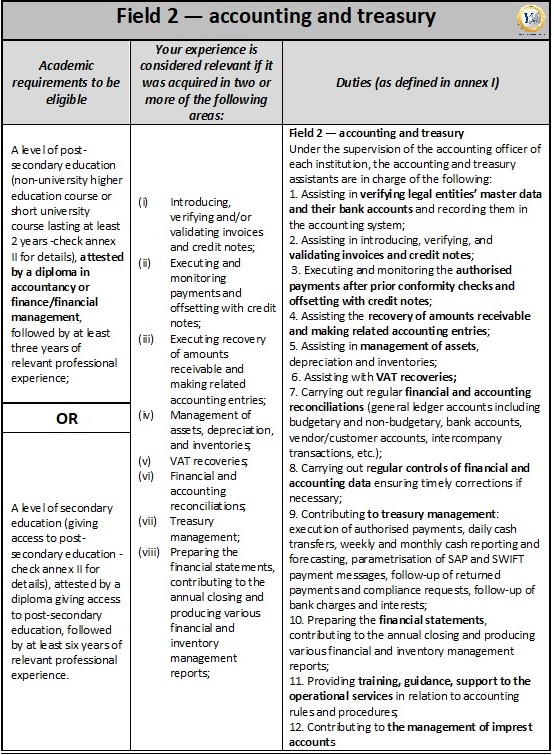
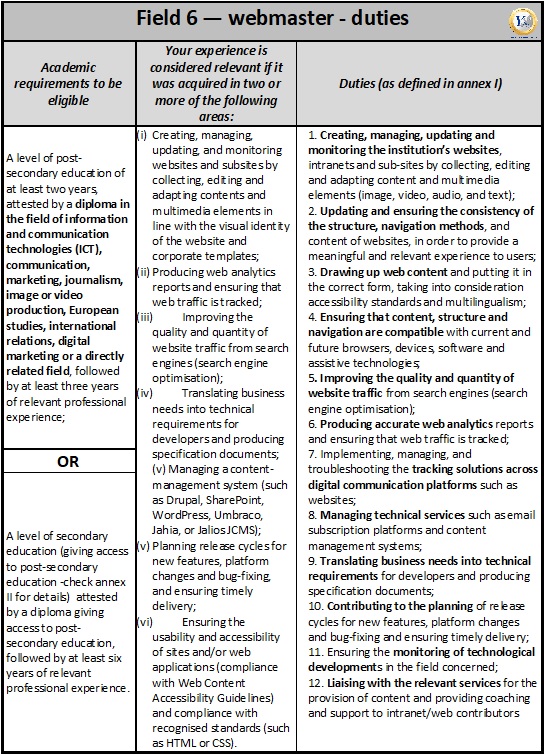
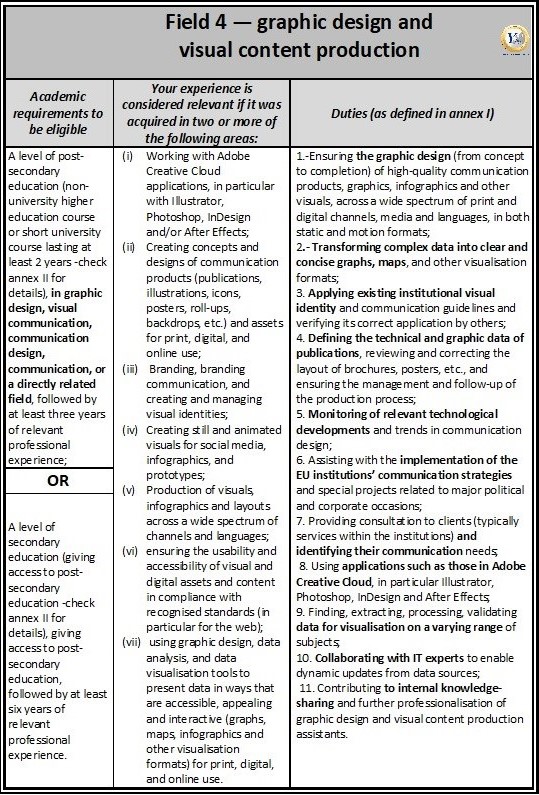
You’ve got until 25 October (noon) to send your application and before that, fill it in with love and care. This is the first step of the process, and the moment to differentiate yourself from the other candidates and all their experience in relation with the six different profiles. So, keep it focused : Work experience + Academic records – these will be used to confirm your eligibility (= whether you have as many years of working experience in the relevant duties as required) so you need to explain your work experience according to the items described in the notice (central and right side column on the tables below).

Field 1 – Financial management & Field 2 – Accounting and treasury

Field 3 – Public procurement & Field 4 – Graphic design and visual content production & Field 5 – Social and digital media & Field 6 -Webmaster (click on the side arrows to change the table)

… (Wait! we are still in phase 1) How can I prove my experience is relevant? This time is up to you and to explain it clearly, by using the key words of the task described as a requirement. Remember you will have to provide evidence of all those experiences described (Check annex III point 1 b) to see what it’s accepted to prove it).

In this way, the responses of all the candidates are structured in the same way, which allows the board to make an evaluation (as objective as such a test allows) of the compared merits of all the candidates. If you think we can be of help, check our past webinar where we focused on tips to fill in the Talent Screener for past specialist competitions. BUT if you are looking for a fresh view on this competition, check our next webinar on the subject on 11 October. webinar( click to see the recording)

Phase 2 – CBT – The reasoning test

Right after ending the period of application, about couple of weeks later, you can expect the time to book your computer-based tests (CBT) test will open, then you will take the test either from home or from Prometric centers during the second half of November and early December. This time the CBT’s bring a hidden surprise.

For Field 1 -Financial management & Field 2 – Accounting and treasury, you will have 15 questions in the numerical reasoning (5 more than usual), while in the verbal only 15 (5 less than usual). To pass, you will need 8 out of 15 in numerical and 12 out of 25 from the combined score of verbal and abstract. BUT, yes now it comes the big BUT, only those candidates who obtain one of the highest scores in the numerical reasoning test will have their application checked for eligibility (and minimum 12 out of 25 for verbal + abstract) by order of results and until they have as many candidates as 3 times the number of spots offered. So it doesn’t matter if you have 10 , 20 or 30 years of relevant working experience, you need a high result in the numerical reasoning.

Pay attention, evil…we mean…the numerical is in the details

And if we go for Field 3 – Public procurement & Field 4 – Graphic design and visual content production & Field 5 – Social and digital media & Field 6 – Webmaster, the picture changes a bit. You will have the usual distribution 20 verbal, 10 numerical and 10 abstract reasoning questions. To pass, you will need 10 out of 20 in verbal and 10 out of 20 from the combined score of numerical and abstract reasoning. BUT, yes now it comes the big BUT for these ones too, only those candidates who obtain one of the highest scores in the verbal reasoning test will have their application checked for eligibility (and also the minimum 10 out of 25 for numerical + abstract).

Almost business as usual but still highest mark in verbal is needed

Phase 3 – Eligibility check

Here you can do nothing but wait. It is the task of the board to read first your CV to see if you have all the years of working experience required. It doesn’t matter if you have 20 or 6 years, once you have passed the threshold of having enough experience you go to the assessment. We remind you that the selection based on compliance with the eligibility conditions will be carried out only for those candidates who pass the CBT and by decreasing order in their result of numerical (profile 1 and 2) or verbal (profiles 3-4-5-6) . You should therefore include all the relevant information in your application form. The best of all this is, after the evaluations, the number of candidates who will go to the Assessment Centre will be only up to 3 times the amount of openings. We are talking approximately 1500 candidates in total and you are one of them because you have written a great application 🏆.

Phase 4 – Assessment Centre.

Congrats! You are one of the candidates with the highest marks in the CBT, you have the required experience and you have been invited to the Assessment Centre. We have reached the final round, in which we will also have to present all our documents related to education and professional experience in digital format (they need to be uploaded into a platform before doing the Assessment Centre tests), so prepare them in advance to avoid a last minute rush with the bureaucracy.

Now talking about the other tests, the competition turns into a classic. You will have to face the following tests: Case Study and Situational Competency-Based Interview. Here you have 7 competences to be assessed (in AD competitions there are eight). Between the two tests you can gather a total of 70 points, with the particularity that you need an overall 35/70 to pass, but no minimum marks per competence. Don’t get over confident, do fine on these two and you will be fine for this part although the more points we get the better (we can help with that).

Some practice, some effort and a some guidance and it will be done 😉
When you see your name on the reserve list

Anyway, the key part is the field-related test where you will have to demonstrate your know how on the field, explaining, in detail, your relevant experience for this position. The Interview in the Field is also somehow structured but as it has a clear focus on your work experience, is much more interesting and rewarding, you can get up to 100 points in that test (we can help on that too), approx. 60% of all the available points.

Final Step – After a long process and passing the Assessment Centre, EPSO will check the validity of all your records and professional experiences (comparing them to the input of your application). For these, they will use the documents uploaded at the beginning of phase 4 – right before your first test of the Assessment Centre. So, keep your documents ready for upload once you have passed the eligibility check!!! Once you get the final OK for this part, you will see your name on the reserve list and ready to find a job as officer of the European institutions.

What is the timing of the competition? When will EPSO contact me?

All the situations under which EPSO will write you in your profile, not by email, although sometimes we may get a warning message.

The expected calendar for this competition is the following: after the closure date for the submission of the applications, mid-November you will have the opportunity to book your CBT slot, then taking the CBT end November, early December. After that, they will run the eligibility checks in Winter, and then the Assessment will come in mid-Spring onwards. So get ready to confront the CBT very soon and the Assessment Centre in Spring 2023!!

Many of you ask about when EPSO will tell you that you have passed to the next phase, or have been invited to the Assessment Centre, or…. you read/heard rumors about the development of the competitions somewhere. Better to isolate yourself from that noise and focus on the real messages. EPSO commits itself (it’s in Annex III of the notice of competition) to communicate with you after the applications have been evaluated to inform you on the results and to invite you to the Assessment Centre. In the meantime, it can take weeks or months to receive any information or being notified that we have passed to the next phase of the competition, so keep calm. If you are feeling desperate for the lack of news, you can always contact EPSO too, as candidates you are entitled to do so but be careful, replies can be a bit cryptic or copy/paste from the notice.

How much will my salary be?

Table of the amounts of basic monthly salaries for each grade and step in function groups AD and AST referred to in Article 66 of the Staff Regulations, applicable from 1 July 2021

One of the most typical questions of the candidates is the salary that you will get. An AST3 (step 2) will join the institutions with a salary starting at 4.500 € and this can be higher depending if you have dependent family members and other conditions. To that amount, you will have to add 16% extra of expatriation allowance and subtract the cost of the taxes (you pay taxes to the European Commission), health insurance and pension, all them proportional to your salary, so expect around the same amount, 4.000 € in net salary. By the way, we refer to step 2 as any first entrant in the institutions can’t join above that step, it means you have at least 3 years of professional experience, what in this competition, is obvious. And if you are worried about life in expensive countries the basic remuneration is supplemented by an allowance linked to the living conditions prevailing at the place of employment, so don’t worry too much.

Can you help me?

Let share some useful links for this competition and any other.

List of useful resources

  1. El CBT o los test psicotécnicos (ES)
  2. The Assesment centre (EN)
  3. 10 free resources (EN/ES).
  4. YSE trainings (English and Spanish) :
    1. CBT (in Spanish)
    2. Assessment sessions – for all the Assessment test (Theory in English or Spanish. Practice can be done in EN,FR,ES)
    3. Application review (EN/ES/FR/IT/DE)
    4. CAST Sessions -have you been invited to a job interview? Do you want to improve your chances of being selected in a CAST process?